
PREFACE
It is extremely difficult for me to translate into words most effectively the joy and satisfaction I personally derived from getting the opportunity
to write this biography. Alhaji (Prince), Osumah A. Ikharo, J.P. (Justice of the Peace) is my uncle whom I equally view as my father. The contents of this biography are drawn from different sources and most notable among them were from Alhaji (Prince), Osumah A. Ikharo himself, oral evidence from Prince Mamudu Jawsay Ikharo, the elder of Ikelebe family and the “odion” of Auchi since January 1, 1991. Other sources of information were evidence from family members and close family friends and of course the report of the Commission of Inquiry into
Auchi Chieftaincy title by Mr. I.K. Odjugo, published in 1971. It is not our intent to slander anyone by any means but to preserve, educate, stimulate and agitate for parity in history. Any genuine criticism is wholeheartedly welcome. I sincerely regret and apologize to anyone who might find any
information contained here unfavorable or unacceptable to him or her.
PRINCE M. M. IKHARO
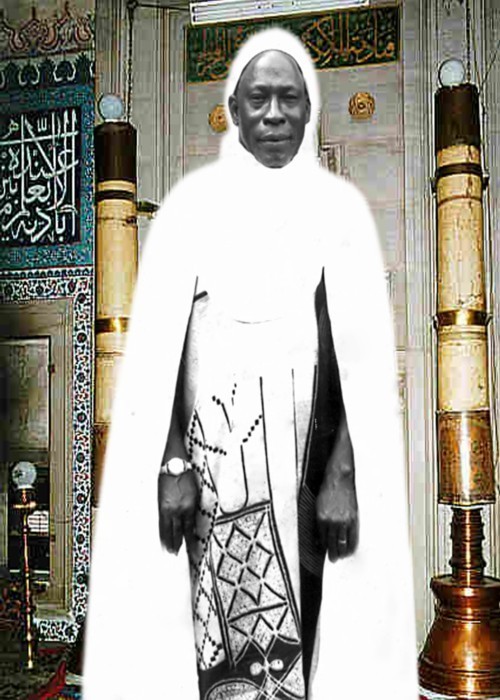
Alhaji (Prince), Osumah A. Ikharo J.P. is the eleventh son of His Royal Highness, late Chief Ikharo Ikelebe, (the fifth Otaru of Auchi) and the third
son of late Madam Fatimah Ikhimeagie alias Ona-Ibie. He was born on Monday, July 4, 1914, into the royal home
- The Onabor/Amoyai type of marriage in which case, full dowr was paid on the bride to the parents, and the offspring from this marriage have full right and privileges of inheritance on the paternal side.
- The Otse type of marriage in which case, no dowry or very small dowry was paid on the bride to the parents and the offspring from this kind of marriage have no rights and privileges of inheritance on the paternal side, but do have full rights of inheritance on the maternal side.
His paternal grandmother, was Princess Okhiaugie Igeh hence she was called Ovbigie alias Ona-Ivbiaro. She was married from Ubuneke in Owan Local Government Area of Edo State by His Royal Highness King Ikelebe Osimhe the first Otaru of Auchi into an Onabor type of marriage. She had only one male named Ikharo Ikelebe.
On his maternal side his grandmother Madam Egbogino alias Ona-Auchi was married from Aibotse in Auchi into an Onabor type of marriage by Pa. Imhotor of South-Ibie Iyakpi. She had four children born into the marriage; namely:- Madam Fatimah Ikhimeagie Ikharo (nee Imhotor), Messrs Musa Enakere Imhotor, Aliu Imoudu Imhotor, and Saliu Orwhei Imhotor.
His later mother Madam Fatimah Ikhimeagie was married from South Ibie Iyakpi by his father into an Onabor type of marriage and had four children viz: Prince Mamudu Jawsay Ikharo, Alhaji (Prince), Audu Ikharo, Alhaji (Prince), Osumah A. Ikharo J.P. and Alhaja (Princess), Mamuna Kadiri (nee Ikharo).
Alhaji Osumah’s father passed away in 1919 when he was just five years old. The death of his father created a fatherhood vacuum which his most senior brother Prince Mamudu Jawsay assumed without any hesitation. Prince Mamudu Jawsay Ikharo had started farming as a career even before he was fully initiated into manhood in 1919 and he was very successful in producing more than enough for his immediate family. Their mother had a very strong positive influence on the children. She made it imperative for her four children to support one another till her death on June 4, 1960. The family had withstood the test oftime and remained as a strong unit despite trials and tribulations over the years.
The Auchi Government School was transferred from Aroko in Owan Local Government Area on May 1, 1922, and Osumah was one the pioneers to enroll and graduate from the school. In 1933, when he was 19 years old, he was initiated into the first cultural step of his age group called Itseba-Igbama age group. Their primary responsibility was to clean all the roads to the neighboring towns and villages.
The following year, the group moved a step forward to another stage called Isomi-Gbama age group whose duty was to clean up all the markets in the town and to construct new roads where necessary. In 1935, at the age 21 his age group graduated into their full manhood followed by an initiation ceremony in the Auchi customary way and from that point on the age group was granted all the rights, privileges and responsibilities enjoyed by adult males within the Auchi community.
On Friday, May 8, 1936, he left home in search of a job to Lokoja. He stayed at Lokoja briefly before proceeding to Kaduna where he got enlisted into
the Nigerian Police Force. He had his police recruit six months training at Kaduna Depot and upon graduation he was transferred to Zaria Police Detachment where he was given his police numerical strength number 7383.
He was awarded a good conduct badge for serving three successful years without any blemish on his record on March 3, 1940. Following the advent of the Second World War there was a shortage in the military personnel in the Nigerian Regiment, serving in the Royal West African Frontier Force. This shortage precipitated the call for volunteers from the Nigerian Police Force. As a dedicated police officer he volunteered to be seconded from the Nigerian Police Force into the army on August 8, 1940.
Two days later he was transferred from the Zaria Police Detachment to form the ninth battalion in the Nigerian Regiment at Enugu in the Eastern Region. On August 17, 1940, his battalion was transferred from Calaba to Accra, Gold Coast now Ghana into the Royal Corps of Signal Training School. Upon the completion of his training he was transferred to the fourth infantry brigade headquarters based at Kaduna in Nigeria and attached to the signal unit.
Eventually, Osumah desired to be married. His two senior brothers Prince Mamudu Jawsay and Alhaji (Prince), Audu Ikharo took it upon themselves to do all the necessary negotiations once the bride to be was identified. This was done, of course, under the tutelage of their mother who has always taught her children to support one another. This marriage was consummated on Thursday, February 6, 1942, with Madam Adama Osumah Ikharo (nee Bria Osiobugie). This marriage was blessed with their first baby boy named Yakubu Osigbemhe Ikharo on Saturday, March 6, 1943. He went on later to marry three more wives and fathered a total of ten children in the following order viz:
- Mr. Yakubu Osigbemhe Ikharo
- Miss Azaratu lye Ikharo (now late)
- Mrs. Fatimatu Emesirai Salami (nee Ikharo)
- Mr. Seidu Aithekhamhe Ikharo (now late)
- Mr. Isa Oshikhena Ikharo
- Mrs. Aminetu Imobiso Akimu (nee Ikharo) now late
- Master Atairu Imaragbor Ikharo (now late)
- Mrs. Sefiatu Itsemeasor Amedu (nee Ikharo)
- Miss Mamunetu Igienekpemhe Ikharo and
- Master Mohammed Tajudeen Amanesi Ikharo
One very interesting thing about him was that he never allowed his commitment to his children to mitigate against rendering a helping hand to his senior brothers, junior sister and their children. A very good case point was that he took two children from Prince Mamudu Jawsay to stay with him and his immediate family in the northern part of Nigeria. This generosity was extended to Alhaji (Prince), Audu’s son Briamah who would later be popularly known as Kano-Boy.
His taking over the raising and the training and nurturing of these children created an everlasting influence on their individual lives. Abdul-Kareem would later grow up to join the Nigerian Police Force before going on to pursue other life endeavors upon his discharge from the force; while Mohammed Jolingo graduated from modern school to teach briefly before proceeding to join the army where he served as a signal officer until his retirement from the military in 1990. Briamah Ikharo, alias Kano-Boy, was also a very successful educator in his own right before he passed away in 1985.
On November 16 and December 20, 1944 he was promoted to the ranks of Lance Corporal and Corporal respectively. He was promoted to the rank of a Sergeant in the army on March 17, 1945, and by June 30, 1945 he was relieved from the army and went back to the Nigerian Police Force with an “exemplary” record of service, and he was awarded the 1939-45 war medal. The police commission reviewed his records from the army, and ordered the normalization of his rank as a Sergeant in the police force. He would later go on to serve the police force in various stations such as Zaira, Kaduna, Makurdi, Oturkpo and finally at Kano where he retired from he police force with an exemplary record of service and pension at the age of 38, on March 31, 1952.
His retirement from the police force did not mean a dormant life. Upon his return to Auchi he started to take an active part in community activities while farming on a subsistence level to support his family.
He was instrumental in creating the first ever birth registration for Auchi natives. He was appointed a member of the Grade “C” customary court on January 9, 1959, by the Western Region. He held this position till the Mid-Western Region (Bendel State) was created in 1967. Note that Bendel State was recently divided into Edo and Delta States with the creation of new states in Nigeria in August 1991.
Following the creation of the Mid-Western Region in 1967, he was appointed by the Ministry of Agriculture and Natural Resources as a member of the Loan Board to the Etsako Farmers. He went on to become one of the first appointees by the Ministry of Social Welfare Division to serve on Auchi Juvenile Court Panel, a position he still holds.
On January 16, 1975, he was again given another governmental appointment to serve as a member of Auchi Development Committee by the Bendel State Government. It should not elude us that Chief Ikharo Ikelebe his father was the fifth Otaru of Auchi who reigned from 1905 to 1919. It is also a well-documented fact in history that Momoh I was Ikharo’s “ukor” (messenger/agent).
There were two factors leading to Ikharo appointing Momoh I, his nephew as his “ukor” viz:
- It would have been unethically immoral for Ikharo to appoint any of his sons to this position otherwise Abdulai, Briamah and or Chief Abu Office could
have conveniently been assigned to do this job. - It would have been regarded as an ultimate insult to his brothers for him to appoint anyone of them to this position and above all this was a crucial
appointment that had to be within the Ikelebe family because of its significance to the Otaru.
These compelling factors forced Chief Ikharo to .search for a vibrant, dynamic, intelligent young man within the family that was capable to represent the Otaru and the Auchi Clan in long distance functions. These qualities were found in Momoh I and subsequently, he was appointed to this representative post. He faithfully represented Ikharo in all functions with Chief Ikharo’s warrant until Ikharo died in 1919.
Upon the demise of Chief A.K. Momoh, the eighth Otaru of Auchi, the government called on the Ikelebe Ruling House to nominate a candidate to fill the vacant stool and what we saw was not unusual since the demise of Momoh I. The Momoh family had two candidates namely: Prince S.M.J. Momoh and Alhaji (Prince), A.G. Momoh and of course the Ikharo family nominated Alhaji Osumah A. Ikharo for the same position. The Ikharo family had vied for this position in 1945, and 1955 respectively but had always been robbed of this chance at the very end. What we saw transpiring here was a case of one single family usurping power to the disadvantage of the entire Ikelebe family. There has been inconsistency in the process and the principle applied in the selection of candidates to take over vacated stool since 1945. One most intriguing thing is that even the Momohs have a tough time convincing themselves what kind of principle or process to apply.
They keep going between D.H. Momoh I’s primogeniture concept and revising back to the “odion” rotatory system within the Momoh family at the exclusion of the other members of Ikelebe sub-ruling families. The notion of primogeniture was a new lexicon that was introduced into the discussion of Auchi chieftaincy by D.H. Momoh I and this was reaffirmed by the scrupulous chieftaincy declaration of 1958. It has been disheartening to see that the government continues to allow this kind of thing to happen to this fine institution. The irony of this proclamation is that it violates the rule of natural justice because Chief Ikharo could have conveniently worked to ensure that one of his sons succeeded him more so when one of his sons Abdulia was senior to Momoh I. In looking back in history of the Auchi chieftaincy ‘from Ikelebe to Ikharo there was no single case of a son succeeding the father directly and the deviant to this rule only ‘occurred in 1945, when Chief M.J. Momoh succeeded his father.
As a result of the strong opposition to the Momohs against putting one of their own on the throne for the fourth consecutive time the government was
compelled to institute the Odjugo Commission of Inquiry. This body was charged to look into, ascertain, report, and make recommendations on the customary law regulating the appointment and succession to the Otaru of Auchi Chieftaincy title, among other things.
The Momohs were not particularly happy about the commission and as a result they decided to blame Prince A.M.G. Igiekhume because they felt that he was responsible for making the government to institute the commission of inquiry. They started engaging in a personal vendetta against him because of his desire to see that justice be rendered in giving a fair shake to other members of the Ikelebe Ruling House, to which he is a
member.
The Odjugo’s Commission did a marvelous job by providing the public and the government with a very comprehensive report. The commission unequivocally recommended that it was Ikharo’s turn to fill the vacant stool and also stated that the Ikelebe Ruling House should be comprised into four sub-ruling families namely:
- Omonofua/Omomo/Igechi sub-ruling family
- Ikharo sub-ruling family
- Abikhiele sub-ruling family
- Idao sub-ruling family among other recommendations.
However, it was an irony of circumstances to see that the government accepted all the recommendations of its commission with the exception of “…the Idao family of which the Momoh family is an off-shoot has had more than its fair share of the Otaruship for over a quarter of an century. They recommended that the Ikharo family should present the candidate to fill the current vacancy.” The government succumbed to the intensive lobbying of the Momohs and instituted an election to fill the vacant stool which went to the favour of Alhaji (Prince), A.G. Momoh with serious wooing of the electorates and this will ever be remembered as a day of infamy in the history of the Auchi people and the Ikelebe family in particular. This was
how Alhaji Osumah A. Ikharo lost his chance of succeeding Chief A.K. Momoh in 1972.
This decision by the government was a reminiscent of what occurred in 1945, when Mr. A.V. Scallon unequivocally recommended that it was the Ikharo family’s turn to present a candidate to fill the vacancy but however, he was over-ruled by the Resident, in charge of Benin Province in 1945.
The government failed in its responsibility to its people by withholding justice in both instances. This is an issue that will continue to agitate the mind
of any rational thinker until the government comes out of its shell to redeem itself and render a true justice. On the alternative the government should
come out with a policy statement to clarify its position as it relates to “electing an Otaru to fill a vacancy that is ever created by the demise of one. If an Otaruship position is to be an elected office the government should consider abrogating the Ikelebe Ruling House as the sole apparent heir to
the throne.
The plausible argument one could surmise for is for the government to set up guidelines and other formal procedure through which a vacancy can be filled. Under this assertion, therefore, it will only be fair and rational to allow other Auchi natives who are interested in becoming an Otaru within Auchi to aspire and contest for any vacant stool regardless of the family from which such a person comes. Under no reasonable decorum should any Auchi native be disfranchised because of his/her religion, education, sex, status of birth, and/or otherwise. The term of office should be established as it is done in any elective position in civilized societies around the world.
No matter how badly one might feel about this crude and unorthodox method of filling a vacant stool some facts in history that were either forgotten
or deliberately hidden or concealed from the public have come to light and it has been reestablished and proved that:
- Chief Ikharo Ikelebe was the fifth Otaru of Auchi.
- D.H. Momoh I was not the first Otaru of Auchi nor was Chief Idao.
- D.H. Momoh I was Chief Ikharo’s “ukor” (messenger/agent) who attended functions at Idah, Fugar and Ubiaja using Chief Ikharo’s warrant.
- Ikelebe Ruling House is the only and the true Royal Family in Auchi.
Ikelebe Ruling House now consists of the following families viz:
- Omonofua/Omomo/Igechi sub-ruling family
- Ikharo sub-ruling family
- Idao sub-ruling family
- Abikhiele sub-ruling family
Momoh family does not constitute a sub-ruling family in itself but a sub-sub-ruling family in effect a .sub-ruling family of the Idao sub-ruling family.
The Ikelebe family and the people of Auchi have been victims of skullduggery by the different governments and the Momohs. It would be an understatement to say that the Ikelebe family could do a whole lot for itself and the Auchi people if only the Momoh family would come to grips with reality and welcome all the other members of the Ikelebe Ruling House to a bargaining table to honestly sort things out and come to a consensus as to how best to handle the issue of appointment and succession to the throne. Whether this suggestion is adhered to or not sooner or later justice will prevail. Although, Alhaji (Prince), Osumah A. Ikharo and his family were denied the opportunity to claim what is rightfully theirs (and left with broken hearts but certainly not broken spirits), what has really happened is the postponement of justice for all.
At the present moment Alhaji (Prince), Osumah A. Ikharo ranks third in the surviving male children of Chief Ikharo Ikelebe as well as in the Ikelebe Ruling House. In 1982, the Otaru of Auchi Alhaji A.G. Momoh (Ikelebe II), was to turban him as the Keisaraki of Usogun but the confirmation ran into a snag when the Otaru wanted him to sworn not to ever vie or consider becoming the Otaru of Auchi forever. As a man of great honor and integrity he refused to be coerced into giving away his natural birth right to intimidation.
In recognition of his selfless services to his community the Bendel State government honored him by appointing him as a Justice of the Peace (J.P.) on August 18, 1991, shortly before the splitting of the state into Edo and Delta States. He is still very much active in community activities while on the other hand he is the chief custodian of his senior brother Pa. Mamudu Jawsay Ikharo who is currently the head of the Ikelebe Ruling House and the “odion” of Auchi as well. One must not fail to mention that he is also a devout Muslim who is guided daily with the tenets of Islam.